

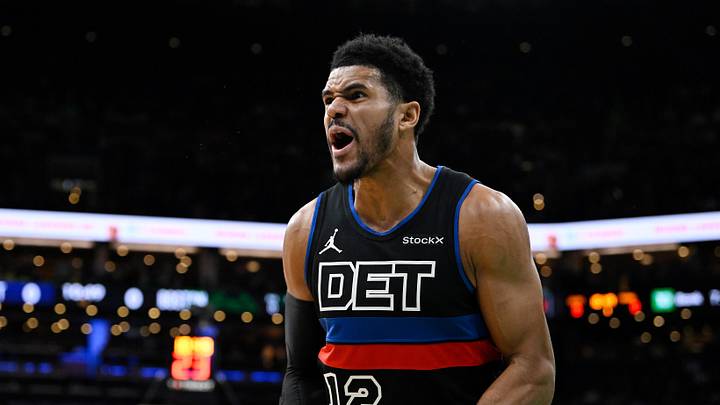
Two years removed from playing his final game for the Philadelphia 76ers, Tobias Harris is thriving with the Detroit Pistons. It's a shift that few saw coming after he developed a reputation as a poor postseason performer with the 76ers.
The question is: Why couldn't the 76ers bring this out of Harris during his six seasons in Philadelphia? Or was his impact simply misunderstood due to the focus on his contract?
Harris has been sublime during the 2026 NBA Playoffs. He's scored at least 20 points in each of the Pistons' past seven games, including the 30 points and nine rebounds he dropped to help Detroit defeat the Orlando Magic in Game 7 of their first-round series, and the 22 and 10 he posted in Game 6.
Harris has carried his quality of play into the Pistons' second-round series against the Cleveland Cavaliers with with 20 points, eight rebounds, and two steals in Game 1 and 21 points, seven rebounds, two blocks, and two steals in Game 2.
To some degree, it's been an unexpected development. The difference between Harris' roles in Detroit and Philadelphia, however, is that the Pistons don't seem to be putting pressure on him to play like a star, but are instead incorporating his strengths and weaknesses into their system and strategy.
No one can deny how monstrous Harris' contract was nor how prohibitive it may have been in the effort to improve the roster, but the Pistons are proving the 76ers should've done more to help him.
Why couldn't the 76ers get this level of play out of Tobias Harris?
Harris routinely came under fire for struggling to deliver in the manner in which Philadelphia expected him to during the playoffs. That struggle was epitomized by his final postseason series with the 76ers, when he averaged 9.0 points on .431/.333/1.000 shooting during a 4-2 loss to the New York Knicks.
Subtract that dreadful series, however, and Harris actually averaged 17.3 points, 8.3 rebounds, 3.1 assists, and 1.5 three-point field goals made on .474/.352/.852 shooting in the playoffs with Philadelphia.
Those numbers may not have lived up to the standard of a five-year, $180 million contract, but they epitomize what Harris routinely provided. He was a productive third option on a team that rightfully wanted more consistency, but also overlooked key points of context.
That includes the fact that Harris was often tasked with playing as a second option due to Joel Embiid's injuries, Jimmy Butler's departure, and Ben Simmons' sudden decline.
Though his contract suggests he should've been up to the task, the 76ers had years to make peace with their reality. Instead, they continuously tasked Harris with playing above his means and lamented the fact that he was more effective in a role they couldn't sustainably give him.
As the Pistons pull within two wins of the Eastern Conference Finals, one can only wonder how different Harris' 76ers career might've been in a more appropriate role.
 Add us as a preferred source on Google