

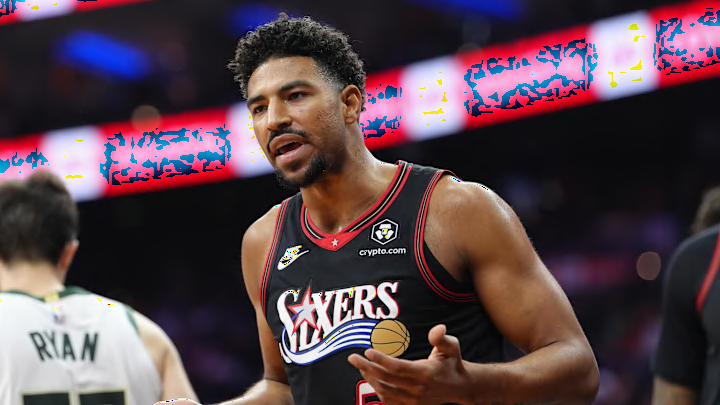
The Philadelphia 76ers’ playoff series against the New York Knicks was nothing short of embarrassing. After being swept with ease by their Eastern Conference rivals, the Sixers must conduct a postmortem of the roster and reevaluate the team’s direction moving forward. There is no better place to start than with Quentin Grimes -- a player who had an opportunity to increase his free agency stock, yet disappeared when his team needed him most, instead diminishing his value.
Quentin Grimes was nonexistent against the Knicks
Philadelphia was always an underdog heading into this series. New York had created inertia after dismantling the Atlanta Hawks in the previous round, while the 76ers were coming off the back of an exhausting seven-game slog against the Boston Celtics. The team needed more than just Joel Embiid and Tyrese Maxey to inspire them to victory; this would require a collective effort.
Instead, fans had to witness a mixture of fatigue, bad performances, and a lack of pride as Philadelphia barely laid a glove on their opponent. While the 76ers had built a reputation for having an insufficient scoring punch from the bench, Quentin Grimes had shown glimpses throughout the 2025-26 regular season that his sharpshooting could ignite his team's secondary unit. That was far from the case in this postseason matchup.
Over the four-game series, Grimes averaged just six points, 2.3 assists, and 1.5 rebounds, while shooting 29.2 percent from the floor. Not only did his efficiency plummet, but his defensive awareness -- much like several of his teammates -- was unacceptable. The volume of failed rotations in Game 4 of the series against the Knicks was criminal. Granted, New York could not miss from three-point range, but Grimes and his teammates were handing out open shots like they were free candy.
A year on, Grimes' value has significantly decreased
Quentin Grimes was arguably Philadelphia's best performer as the 2024-25 season came to a close. However, this campaign has failed to enhance his reputation as a scoring guard, and if anything, has shown that without free rein of the offense, his impact on a team could be considered negative.
Last year, Grimes' bargaining chip was the rate he was putting up points on a severely weakened 76ers' roster. After joining the Sixers in a trade from the Dallas Mavericks, the 26-year-old averaged 21.9 points, 5.2 rebounds, and 4.5 assists per game. Even at the time, fans of the franchise understood that level of production was unlikely to be sustainable once key rotation players returned. Still, in a sixth-man role, Grimes appeared to have the potential to remain productive.
On one hand, Grimes did meet these expectations during the regular season -- he recorded 13.4 points, 3.6 rebounds, and 3.3 assists per game. Nevertheless, if a player really wants to raise their value, especially as an impact scorer from the bench, these numbers must be mirrored in the postseason, and this was far from the case as the 76ers fell to defeat against the New York Knicks.
Where Quentin Grimes now stands in the eyes of potential suitors is unknown. After providing evidence that his scoring impact from a secondary role is nonexistent in the games that matter most, it is unlikely that an organisation will hand him a bumper contract. Additionally, his weakened reputation will prevent front offices from handing him a star role on a roster.
One thing is certain: the Philadelphia 76ers cannot afford to commit a significant portion of their future salary cap to a player who has shown he is incapable of making a meaningful impact in the role he was given.
 Add us as a preferred source on Google