

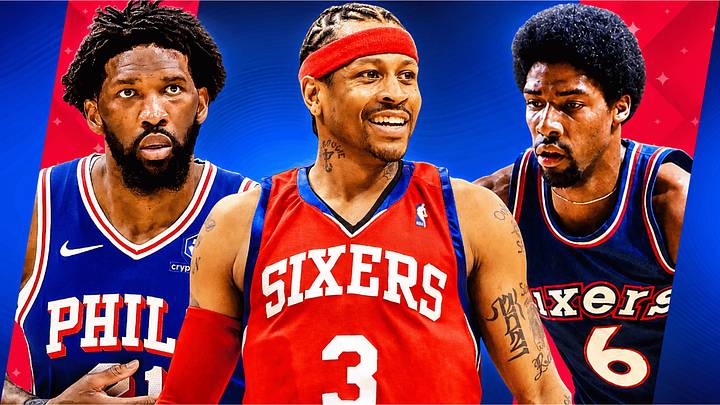
Who is the greatest player in the history of the Philadelphia 76ers?
While the names at the very top might be familiar, expanding the task to the top 30 casts a net over a franchise with a very long history. The franchise can trace its roots back to the very start of the NBA, beginning as the Syracuse Nationals and moving to Philadelphia to become the 76ers.
Ranking the best players is a combination of peak and longevity, of quality and quantity. One elite season is meaningful, but ten really good ones are as well. This list will try to factor in awards, stats, impact, longevity, and, perhaps most of all, postseason success.
This ranking is of great importance at the time of writing, as the 76ers have landed a couple of new stars in Jaylen Brown and LeBron James. How high could they climb on this list by the time they move on? Could LeBron claim a spot on the list for yet another franchise? Can Brown become one of the greatest 76ers of all time?
We begin with No. 30, an icon of the tanking years, and end with the greatest winner in the history of this storied franchise.
No. 30: Thaddeus Young
One of the mainstays of the Process era of Philadelphia basketball, Thaddeus Young had a real impact on winning despite the losing environment around him. He played in 516 games across seven seasons with Philly, first playing a prominent role on the Andre Iguodala playoff teams and then being a cornerstone of the tanking teams. He ranks 19th in franchise history in win shares and 1st in NBA history in fantastic graphics.
No. 29: Theo Ratliff
6'10" power forward Theo Ratliff joined the 76ers via trade in 1997, and head coach Larry Brown immediately plugged him into the starting lineup. He played five seasons in Philadelphia, making an All-Defense team in 1999 and the All-Star Game in 2001, when he led the league in blocks. In fact, Ratliff ranks second all-time in franchise history in blocks per game at 2.9, just behind short-time Sixer Shawn Bradley.
No. 28: Jrue Holiday
Before he was the ultimate championship-winning support player, Jrue Holiday was a young offensive star for the Philadelphia 76ers. Drafted 17th overall out of UCLA in 2009, Holiday played four seasons with the 76ers, earning an All-Star nod in 2012-13. He was then traded to kick off the tanking years, and Philly may still regret that decision.
No. 27: George King
While better known for his accomplishments as a college basketball coach, George King was a point guard from West Virginia who joined the Syracuse Nationals in 1951 and played five seasons for the team. King played a key role on the first championship team in franchise history, including hitting the series-clinching free throw and recording a key steal to win the 1955 title. His numbers were pedestrian, but his playoff impact lands him on the list.
No. 26: Steve Mix
Longtime 76ers broadcaster Steve Mix got his start with the team in 1973, signing as a free agent and playing nine seasons in Philly. The 6'7" forward was a double-double machine when he first arrived and made the All-Star team in 1975. Mix then later settled into a support role as the team added stars such as Julius Erving, Bobby Jones, and Darryl Dawkins. He came off the bench for three different teams that reached the NBA Finals but didn't get to celebrate the team's title in 1983, as he was already off the team on the cusp of retirement.
No. 25: George McGinnis
A star with the Indiana Hoosiers who then dominated in the ABA with the Indiana Pacers, George McGinnis saw his NBA rights held by the 76ers, and he joined the team in 1975 after winning ABA MVP the previous season. He would finish fifth in MVP voting in his first season in Philly. In total, he made two All-NBA teams and averaged 21.6 points per game during his three seasons with the team.
Injury issues hit during the team's run to the 1977 NBA Finals, and McGinnis played poorly as the Sixers lost in six games to Bill Walton and the Portland Trail Blazers. Philadelphia traded him the next season to the Denver Nuggets for defensive star Bobby Jones.
No. 24: Andre Iguodala
Before he was Finals MVP for the Steph Curry Warriors, and before he was a Team USA glue guy in the Olympics, Andre Iguodala was a do-everything star for the Philadelphia 76ers. He stepped up as the team's star after Allen Iverson was traded in Iggy's third season, and Iguodala would go on to play in 82 games five different times in his eight seasons in Philly.
Iguodala, somewhat surprisingly, only made one All-Star Game for the team. Still, he was a perennial Defensive Player of the Year candidate and averaged a prolific 15.3 points, 5.8 rebounds, 4.9 assists, and 1.7 steals in his 615 games for the franchise. Without a number one offensive star, however, Iggy's playoff success was muted. He was traded in the summer of 2012 as the Sixers began to tear down their mediocre playoff teams to tank their way into stars.
No. 23: Doug Collins
While younger fans know Doug Collins as a head coach, he was once an All-Star shooting guard who played all eight seasons of his career in Philadelphia. The first overall pick in the 1973 NBA Draft, Collins started on both good and bad teams in Philly. He averaged 40 minutes and 22.4 points per game on the 1977 NBA Finals team. Injuries ended his career early, and he didn't get to celebrate the 1983 title, as he retired in 1981.
No. 22: Archie Clark
Combo guard Archie Clark gained fame for popularizing the crossover dribble, and his ability to keep the ball on a rope as he navigated defenders allowed him to thrive in the NBA despite his 6'2" frame. After starting his career with the Los Angeles Lakers, Clark landed in Philly as part of the Wilt Chamberlain trade in 1968. He played three years (plus one game) for the 76ers, averaging a stout 18.2 points and 4.7 assists per game. His impact on winning went beyond his stats, even if his time in Philadelphia was relatively short.
No. 21: Andrew Toney
Another 76ers lifer, Andrew Toney was the eighth overall pick in the 1980 NBA Draft and would play all eight seasons of his career in Philadelphia. Known somewhat uncomfortably as "the Boston Strangler" for his impressive performances against Larry Bird and the Boston Celtics, Toney played a key role on multiple NBA Finals teams, including starting on the 1983 title team.
A two-time All-Star, Toney's prolific scoring as a shooting guard proved pivotal alongside defensive stalwart Maurice Cheeks. His career was cut short by foot issues that caused his game to decline sharply over his last three seasons. In the end, his time in Philly was a hot start and a cold and fast end.
No. 20: Dikembe Mutombo
Dikembe Mutombo played just 1.5 seasons in Philly, but he was absolutely dominant in the midst of his prime. One of the greatest shot-blockers in NBA history swatted everything in sight for the 76ers, averaging 2.4 blocks per game and 11.2 rebounds. He won Defensive Player of the Year that first season and finished third for DPOY in the second, making an All-NBA team both times. He started at center for the 2001 team that went all the way to the NBA Finals. It was a brief but bright run of 106 regular-season and 28 playoff games for Mutombo in Philadelphia.
No. 19: Caldwell Jones
The Philadelphia 76ers drafted big man Caldwell Jones in 1973, but he would first go to the ABA as a shot-blocking monster -- his 12 blocks in a single game is the ABA single-game record. It wasn't until 1976 that he joined the 76ers and played six seasons with the team. He started at center next to Bobby Jones and formed the league's best defensive frontcourt, making two All-Defense teams.
Three times those Philly teams won the Eastern Conference only to fall short of a title, and in 1982, Jones was the centerpiece of the package traded to the Houston Rockets for Moses Malone. In total, he played 482 games for the 76ers, averaging 7.2 points, 9.2 rebounds, and 1.9 blocks. He ranks 12th in franchise history in defensive win shares.
No. 18: Darryl Dawkins
When Stevie Wonder gives you a nickname, you know you're doing something right.
Darryl Dawkins was first well-known for entering the NBA directly out of high school, and later for his incredible rim attacks and dazzling array of dunks. His shattering of multiple rims led the NBA to adopt breakaway rims, and his nickname "Chocolate Thunder" from Wonder only added to his mystique.
His play on the court was more up-and-down than his fame suggests, as he spent much of his career coming off the bench. For a few seasons, however, he supplanted Caldwell Jones as the starting center for the 76ers in the early 1980s. He was traded after the team's third NBA Finals loss in 1982, as part of a series of moves that brought Moses Malone to Philly.
No. 17: Hersey Hawkins
Many of the players on this list played key roles on 76ers teams in the '70s and early '80s, but Hersey Hawkins was on the less-heralded late-'80s teams, where he was the Robin to Charles Barkley's Batman. Hawkins started his career in Philadelphia and played five seasons for the team, combining a smooth scoring attack with quick hands on defense. The one-time All-Star ranks 17th in team history in win shares despite his relatively short time with the team.
No. 16: Red Kerr
Johnny "Red" Kerr was a basketball fixture for six decades, from player to coach to broadcaster, most famously making key calls during Michael Jordan's career with the Chicago Bulls.
Before all of that, however, he was the sixth-overall pick in the 1954 NBA Draft by the Syracuse Nationals. He played so well as a rookie that he earned his way into the rotation alongside the likes of Dolph Schayes and George King. He averaged 33 minutes per game as a rookie on the team that won the 1955 NBA Finals.
He would spend the next decade with the team, moving with them from Syracuse to Philadelphia to replace the Warriors. He was a three-time All-Star, finishing sixth in MVP voting in 1963. In all, he played 834 games for the franchise, 5th-most all-time. When he was selected by his hometown Chicago Bulls in the 1966 expansion draft, he chose to retire and take over as head coach instead.
No. 15: Larry Costello
Larry Costello did the Philadelphia two-step. The New York native began his career with the Philadelphia Warriors, then joined the Syracuse Nationals, who later moved with Costello back to Philly and became the 76ers. He played alongside Dolph Schayes and Red Kerr for seven full seasons, the All-Star point guard diming up his frontcourt partners.
Costello made six All-Star Games in his 10 seasons with the franchise, retiring at one point before coming back at the request of head coach Alex Hannum. He was the backup point guard on the dominant 1967 title team, although he didn't play in the NBA Finals, and Costello ruptured his Achilles in 1968, finally ending his run. He played 615 regular-season games for the franchise.
No. 14: Chet Walker
Small forward Chet Walker is a key player in the history of two different franchises. He began his career in 1962 with the Syracuse Nationals, making the All-Rookie Team and then moving to Philadelphia with the rest of his teammates. He would make the All-Star Game as a sophomore, and his career kept going from there.
Walker played seven seasons for the franchise, making three All-Star Games and not missing a single game for the final four seasons. He won a ring in 1967, starting alongside the likes of Wilt Chamberlain, Hal Greer, and Lucious Jackson. He averaged a stout 18.9 points in a whopping 58 playoff games for the franchise.
He was traded to the newly founded Chicago Bulls in 1969, and he would make another four All-Star Games as the first franchise star in that team's history.
No. 13: Ben Simmons
The tragedy of Ben Simmons has surely left a bitter taste in the mouths of modern Sixers fans, but the truth remains that Simmons was wildly impactful at the start of his career. Drafted first overall out of LSU, Simmons was as individually prolific in the NBA as he was in college. He won Rookie of the Year and nearly averaged a triple-double in 2017-18.
He made the All-Star team in the next three seasons, twice earning All-Defense honors and once making an All-NBA team. His combination of playmaking, finishing, and rebounding was electric, and he was a defensive monster, defending multiple positions.
The problem with Simmons? He couldn't shoot, from the field or from the stripe, and it appeared to break him mentally. He passed up shots, avoided the paint late in games, and most notoriously passed the ball instead of taking a game-winning shot at the rim in Game 7 of a second-round playoff series against the Atlanta Hawks. His career has nosedived since then, but for four seasons, he was a two-way star.
No. 12: Tyrese Maxey
Other than Jaylen Brown, LeBron James, or V.J. Edgecombe breaking onto this list, the most potential for movement comes from Tyrese Maxey at No. 12. Another strong season could push him into the top 10, especially if the 76ers can make a deep run in the playoffs.
Maxey was a steal at pick number 21 out of Kentucky, a protected pick the 76ers almost lost and got back on the last night of the season. The combo guard eased into his career and then exploded in his third season, averaging 20 points per game despite toggling between the starting lineup and the bench. By that fourth year, he fully arrived, winning Most Improved Player and making his first All-Star Game.
Last season was yet another level up, as Maxey led the league in minutes and averaged 28.3 points and 6.6 assists per game. He also brings a high level of compete on defense, not a given among his fellow backcourt stars in the league. He is only six years in, but already he is racking up accolades and is the franchise leader in made 3-pointers. The arrow is pointing up for Maxey.
No. 11: Billy Cunningham
One of the OG super-subs, Billy Cunningham was the Sixth Man for some dominant Philadelphia teams in the 1960s and '70s. Nicknamed "The Kangaroo Kid" by some, the 6'6" Cunningham was drafted by the 76ers with the seventh pick and finished second in Rookie of the Year voting the following year. He would spend seven straight seasons with Philly, making four All-NBA teams as he ascended into the starting lineup after Wilt Chamberlain departed the franchise.
Cunningham left the team to play in the ABA for his hometown Carolina Cougars, where he won league MVP. He returned two years later and finished his career with the Sixers, tallying 654 games played across nine seasons with the franchise. He averaged 20.8 points, 10.1 rebounds, and four assists per game.
No. 10: Maurice Cheeks
Maurice "Mo" Cheeks made his NBA debut in 1978 after being drafted in the second round, and he immediately earned the starting job and would hold it for the next 11 seasons. One of the league's premier defenders at the point of attack, Cheeks made five All-Defense teams and finished as high as third in Defensive Player of the Year voting. Four different times, his steady hand as a passer and tenacious defense earned him an All-Star berth.
Cheeks was also at the point for many of the most successful 76ers teams of all time, playing in 115 playoff games across 10 different postseasons. Three times, Philly made it to the NBA Finals during his tenure, including winning the championship in 1983. He remains the franchise leader in assists and steals by substantial amounts and ranks third in games played. Only Julius Erving played in more playoff games.
No. 9: Bobby Jones
Bobby Jones was a two-way star in the ABA, finishing as high as second in the MVP voting. He then transitioned to the NBA and became one of the best defenders in the league, a 6'9" tornado on defense who stymied all of the league's most impressive offenses in the 1970s and 80s.
Jones was an 11-time All-Defense selection and played in multiple NBA Finals, including winning the 1983 title with Philly. The "Secretary of Defense" was the greatest defensive player in franchise history.
No. 8: Joel Embiid
One of three 76ers to win an MVP award, Joel Embiid had a handful of seasons where he was right at the top of the league, finishing as the MVP runner-up multiple times as well. His touch as a scorer and his sheer overwhelming size as a paint protector were truly formidable.
The rest of the story with Embiid is how injuries slowed the start of his career, limited its ceiling, and will probably end it prematurely. A deep playoff run where Embiid is healthy and dominating would go a long way toward redefining his legacy. As it is, he had massive highs and disappointing lows.
No. 7: Hal Greer
A combo guard from West Virginia, Hal Greer joined the NBA in 1958, playing for the Syracuse Nationals. He would play his entire 15-year career with the franchise, moving with them to Philadelphia ahead of his sixth season.
Greer made 10 straight All-Star Games, including seven straight All-NBA nods. He ranks first in franchise history in all manner of categories, from games and minutes to points, field goal makes, and personal fouls. In fact, when he retired in 1973, he was the NBA's all-time leader in games played (he is now 83rd). Greer became the first 76ers player in franchise history to have his number retired; no player has worn No. 15 since.
No. 6: Charles Barkley
If the goal was to rank the greatest personalities in 76ers history, Charles Barkley may rank first -- perhaps in NBA history as well. Known by everything from "Chuck" to "The Round Mound of Rebound" to "Sir Charles," he had a truly impressive career, the first eight seasons of which he spent with the 76ers.
Barkley received MVP votes every season he was with Philadelphia from his second season on, finishing as high as second; he would win the MVP in his ninth season after joining the Phoenix Suns. Barkley was undersized as a power forward but incredibly strong and savvy in his positioning and movements; he sucked in rebounds like a vacuum cleaner, averaging 11.6 boards per game with the team. Add in 23.3 points and 3.7 assists, and you get an unstoppable offensive force.
Barkley never saw true team success in Philadelphia, and they eventually traded him to the Suns in 1992.
No. 5: Allen Iverson
Some lists will rank Allen Iverson much higher than this, and he certainly had a massive cultural impact on both the 76ers and the NBA. He was a relentless scorer, averaging 27.6 points over 12 seasons with the Philadelphia 76ers. In 2001, he won the league MVP, leading Philly to the NBA Finals. The Sixers built a defensive juggernaut around Iverson as the heliocentric engine.
Five times, Iverson led the league in scoring; he also led the league in minutes seven times, and field goal attempts six times. His efficiency left much to be desired, shooting 42.1 percent from the field and 30.9 percent from 3-point range. He was also a master at timing his gambles to steal passes, averaging a whopping 2.3 steals per game for his Philadelphia career, but if he didn't steal the ball, he was a defensive sieve.
All in all, Iverson's ranking on this list was difficult. Huge impact, huge weaknesses, plenty of style.
No. 4: Moses Malone
A trailblazer for entering the league directly out of high school, Moses Malone joined the 76ers in 1982 after years of dominating for the Houston Rockets. He won MVP in his final season with the Rockets and followed it up with an MVP season for the Sixers in 1983. He played four seasons in Philly and was a monster for all four, leading the league in rebounding three of those years and free throws three times as well.
Malone was a behemoth at the center position, unlocking the top-end upside of a Philadelphia team that was at the top of the East for a decade without winning it all. They won the title in 1983, nearly going "Fo-Fo-Fo" as Malone promised at the start of the playoffs by winning the championship in just 13 games, 12-1 for their entire run. Per game, Malone was the best player in franchise history, and if he had spent more than four seasons with the team, he may have landed at No. 1.
No. 3: Wilt Chamberlain
Wilt Chamberlain landed in Philadelphia in 1965 and promptly ripped off three straight MVP awards. One note first, since it trips people up: his 100-point game came in 1962 for the Philadelphia Warriors, a different franchise that moved to San Francisco the following year. It isn't part of 76ers history.
Chamberlain returned to Philadelphia, landing with the team in 1965 and promptly ripping off three straight MVP awards. He was an unstoppable scoring force, a mammoth rebounder, and even his passing was unlocked while with the team. His per-game stat line of 27.6 points, 23.9 rebounds, and 6.8 assists while with the team was truly mind-boggling.
While Chamberlain's legacy is about driving stats over winning, that is not fair to the quality of the teams he played on. In three of his four seasons with the team, he was a part of deep playoff runs, including the championship in 1967.
No. 2: Dolph Schayes
The 6'8" New York native was a true trailblazer in professional basketball -- in essence, one of the first stars of the league that would soon become the NBA. He was drafted in 1948 by both the New York Knicks and the Syracuse Nationals, and the Nationals offered more money -- a whopping $7,500. He won Rookie of the Year, and the next season the NBA formed.
From there, Schayes ripped off a 15-year, Hall of Fame career entirely for that one franchise -- they would move to Philadelphia in his final season, 1963-64. He was a 12-time All-Star and 12-time All-NBA selection, receiving MVP votes six different times. His best season was likely 1957-58, when he finished second in MVP voting and put up 24.9 points and 14.2 rebounds. For his career, he averaged 18.5 points, 12.1 rebounds, and 3.1 assists.
Three times he played in the NBA Finals with the team, and they won the 1955 title. No one in franchise history has more All-Star or All-NBA selections, only the No. 1 player on this list has more playoff win shares, and he set the tone for what a Philadelphia star would look like.
No. 1: Julius Erving
The unquestioned No. 1 player in the history of the Philadelphia 76ers is Julius Erving. He may not have won the most MVPs (Wilt has three) or played the most seasons (Dolph Schayes played all 15 years of his career with the team), but Erving combined excellence, playoff success, and longevity to take the top spot.
In terms of accolades, he has plenty—an MVP award of his own, 11 All-Star Games, and seven All-NBA selections. Dr. J was the best player in the ABA for five years, then joined the 76ers in 1976 and never looked back. Four different times he led the 76ers to the NBA Finals, finally winning the title in 1983. A two-way force, Erving was dunking, passing, rebounding, blocking, and flying everywhere around the court.
From his iconic look to his tomahawk dunks to his dazzling personality, Erving was a superstar and helped to define an entire era of basketball in Philadelphia. He ranks No. 1 as the greatest 76er of all time.
 Add us as a preferred source on Google